
Stepping into Curiosity Before Feedback
We use our brains every day for our careers, but we don’t often stop to think about how truly wild our brains are. They generate all sorts of thoughts, ideas, judgments, and assumptions—often without any prompting at all. It’s part of how we solve problems and make sense of the world around us.
But brains also have a dark side. They are storytellers.
Sometimes the stories are empowering. But other times, our brains create stories that undermine us, damage relationships, and keep us stuck.
And I hear those stories from clients all the time.
Joe dominates our team without regard for others. He doesn’t fit in.
Anne is difficult to work with.
Jennifer just isn’t getting her job. She seems lost.
I’m obviously incapable of managing my team.
Shannon is such a strategist. I’ll never measure up.
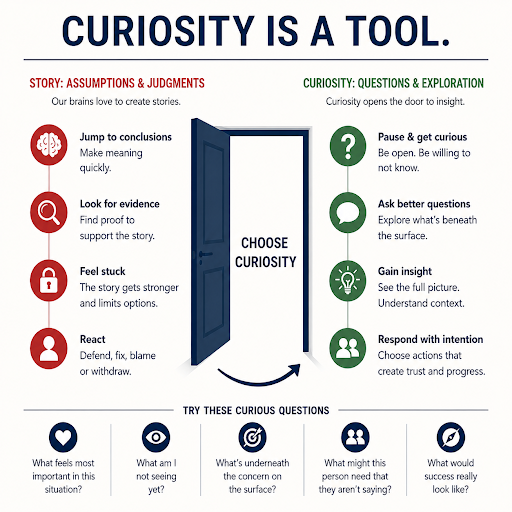
Once a story takes hold, we tend to lean into it.
This person is difficult.
That team doesn’t work well together.
I’m not valued.
They don’t understand.
And then our brains go to work gathering evidence. We start looking for examples that confirm the story. The narrative grows stronger and stronger until eventually we feel trapped inside it.
I can’t work with this person.
I’m not a good performer.
My boss is incompetent.
This job won’t work for me.
My boss doesn’t appreciate me.
My staff member doesn’t have the capacity to course correct.
The stories take hold.
To be clear, the facts of the situation may absolutely be true. You might find yourself having the same conversation over and over with the same staff person. You might work with someone who dominates conversations or struggles to listen. You might notice your confidence drop every time you interact with a certain team.
But there is a big difference between facts and a story.
The facts are the situation.
The story is what we make those facts mean.
And when we fully believe the painful story (They don’t appreciate me. I’m not confident. I’ll never fix this. This person is difficult) we often skip over something crucial:
Curiosity.
Curiosity is the doorway that allows us to look at the same facts through a different lens.
I see this often with coaching clients, many of whom are managers navigating difficult relationships with direct reports. The employee may be pushy, slow to initiate work, inconsistent in follow through, or struggling with projects that the manager believes should be straightforward.
The manager feels stumped. They often feel they’ve already tried everything, including direct feedback and repeated conversations intended to course correct. By the time I’m speaking with my client, many of them feel there are no good options left.
But then I ask a few questions:
What are you wondering about this person?
What feels like it might be underneath the surface here?
And suddenly, the conversation shifts.
The client usually has quite a bit to say. As we explore further, it becomes clear there are important dynamics that haven’t yet been fully investigated.
Does this person actually have the skills they need to do the job successfully?
What context might the staff member have that the manager is missing?
Are they feeling unsupported or unclear about expectations?
Are they lacking confidence in how to proceed?
What do they think is contributing to the challenge?
What are they genuinely struggling with?
These questions represent a strategy of curiosity—which, by definition, requires us to temporarily set our chosen story aside.
Curiosity means asking deeper questions before rushing toward conclusions.
And we can ask ourselves a lot of questions:
What feels most important in this situation?
What am I not seeing yet?
What concern is underneath the concern on the surface?
What does success really look like here?
What are you seeing that I may not be seeing?
What problem are you trying to solve?
What feels hard about this right now?
What’s crucial is moving away from the primary storyline our brains tend to create: Who caused this problem?
Our brains naturally look for the villain. But most of the time, there isn’t one. There are simply human beings trying to navigate complexity together.
Curiosity is a foundational coaching skill. And truthfully, it was not one that came naturally to me when I first became a coach. Like many leaders and managers, I was often more comfortable moving quickly toward solutions, advice, or conclusions.
But over time, I learned that curiosity is not passive. It is one of the most powerful leadership tools we have.
The most radical shift you can make as a leader is not being the one with the fast answers but being able to help people uncover what the real challenge actually is. It’s being willing to stay curious a little bit longer rather than rushing toward certainty.
Curiosity means slowing down long enough to ask:
What else could be true here?
What might I be missing?
What does this person need that they may not know how to articulate yet?
And this kind of curiosity only works if the attitude behind it includes a genuine desire to hear what the other person has to say. Not listening to respond. Not listening to defend your point. Listening to actually understand.
That’s what creates empathy.
That’s what builds trust.
And that’s what allows us to choose responses that are more thoughtful, grounded, and effective.
This matters even more in leadership because power changes conversations. People with less authority are often carefully assessing whether it is truly safe to speak honestly. If leaders move too quickly into judgment, fixing, defensiveness, or advocacy, curiosity disappears from the room.
As leaders, we have to ask ourselves:
Am I asking questions to understand or to persuade?
Am I creating enough safety for people to tell me what is actually happening?
Am I genuinely open to hearing something different than the story I’ve already created?
Because often our questions are not really questions at all. They are disguised conclusions:
“Don’t you think we should…?”
“Why didn’t you…?”
“Have you considered…?”
“Wouldn’t it make more sense if…?”
Those questions subtly communicate: I already know the answer.
Real curiosity sounds different.
It sounds like:
“Can you walk me through how you’re seeing this?”
“What feels most challenging right now?”
“What am I missing?”
“What would support look like here?”
“What do you think needs to happen next?”
Curiosity does not mean avoiding accountability, difficult conversations, or hard truths. It simply means we stop assuming we already fully understand the situation before we investigate it more deeply.
And perhaps most importantly, curiosity interrupts the stories our brains create about ourselves.
I’m failing.
I’m not capable enough.
I’ll never figure this out.
They don’t value me.
The moment we step into curiosity, we create space for something else to emerge: possibility, clarity, understanding, connection, and sometimes even compassion.
Not every situation changes.
Not every relationship improves.
Not every challenge resolves neatly.
But curiosity gives us a chance to respond to reality instead of only reacting to the story we created about it.
And that shift can change almost everything.