

Start your journey to personal sustainability, discover well-being strategies, and achieve balance and happiness now!
Blog
What do you want to explore today?



Emotional Intelligence Doesn’t Mean Keeping Everyone Happy
Emotional intelligence doesn’t mean keeping everyone happy or avoiding uncomfortable conversations. For leaders, it means understanding emotions—both your own and others’—while still addressing what needs to be addressed. Empathy can help you understand someone’s reaction, but it doesn’t require you to remove their discomfort, change a sound decision, or avoid accountability. Emotionally intelligent leadership also involves self-awareness, self-management, adaptability, conflict management, and clear communication. By learning to manage your own reactions and respond with both care and clarity, you can navigate difficult conversations while protecting trust, strengthening relationships, and keeping the work moving forward.
What If You Had an Energy Budget?
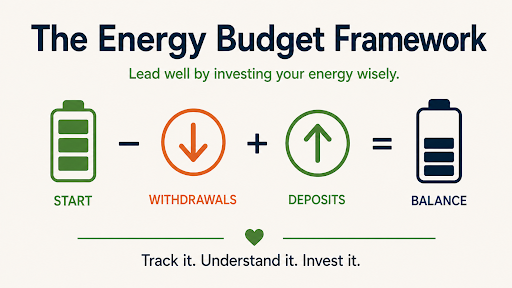
Most of us carefully budget our money, but how often do we stop to think about where our energy goes? For purpose-driven leaders, exhaustion often isn't caused by a lack of time—it's the result of investing energy without intention. The good news is that small shifts can make a significant difference. By becoming more aware of what energizes and drains you, you can lead more sustainably, make better decisions, and protect your wellbeing. In this week's blog, I share a simple framework for creating an "energy budget" and introduce a complimentary workbook to help you start managing your energy more intentionally.
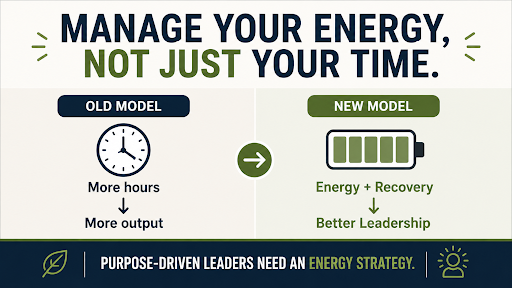
Why Purpose-Driven Leaders Need an Energy Strategy
Purpose-driven leaders often focus on managing their time, believing better productivity will solve overwhelm. But the real challenge may be managing energy instead. Every decision, meeting, interruption, and difficult conversation draws from a limited reserve, making it harder to bring your best thinking to the work that matters most.
Sustainable leadership isn't about pushing harder or working longer. It's about understanding your personal energy patterns, protecting your highest-energy hours, and intentionally building moments of recovery into each day.
When you learn to recharge as intentionally as you lead, you create the capacity to make a greater, lasting impact.
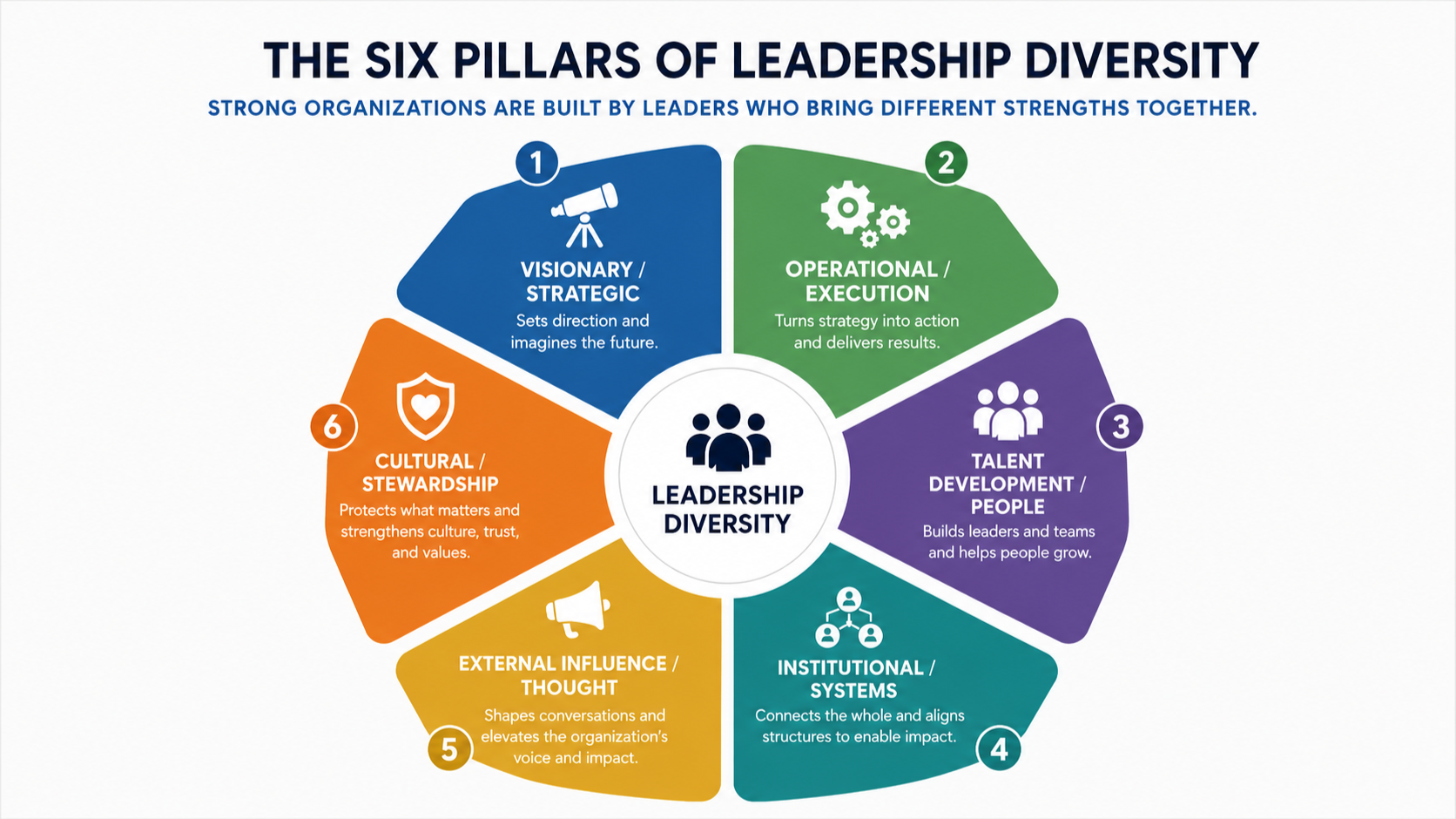
Leadership Diversity: Why Organizations Need More Than One Type of Leader
Many organizations unknowingly fall into the trap of valuing one leadership style above all others. Yet sustainable success rarely comes from a single type of leader. High performing organizations need visionaries who imagine the future, operational leaders who drive execution, people developers who grow talent, systems thinkers who connect the pieces, thought leaders who influence beyond the organization, and culture stewards who protect values and trust. This article explores the importance of leadership diversity and highlights six core leadership pillars that help organizations build stronger teams, foster resilience, strengthen collaboration, and create lasting impact in an increasingly complex world.

Stepping into Curiosity Before Feedback
Our brains are natural storytellers. They constantly create meaning from the situations, conversations, and challenges we experience at work and in life. But sometimes those stories limit us, damage relationships, and keep us stuck in assumptions that may not tell the full truth. This blog explores the difference between facts and the stories we attach to them, and why curiosity is one of the most powerful leadership tools we have. By slowing down, asking better questions, and staying open to understanding rather than judgment, we create space for empathy, clarity, stronger communication, and more thoughtful responses in both leadership and everyday interactions.

Why Smart Teams Still Get It Wrong: How fast thinking, hidden biases, and overconfidence quietly derail good decisions-and why pausing matters
Most of us like to believe we’re thoughtful decision-makers, yet much of what drives our behaviour happens on autopilot. Research suggests that up to 40–50% of our daily actions are habitual, including how we think, respond, and lead.
In fast-paced environments, we often rely on familiarity, assumptions, and quick judgments. While these patterns are efficient, they are not always effective. Drawing on Daniel Kahneman’s work, this article explores the difference between fast, automatic thinking and slower, more deliberate thinking. The challenge is not that we think too slowly, but that we rarely pause. Without that pause, important decisions can suffer.

When Everything Feels Urgent at Work — 3 Shifts to Lead More Intentionally
Many leaders begin the week with good intentions, yet their days quickly disappear into emails, meetings, messages, and urgent requests. Over time, this creates a pattern of reactive leadership, where responding takes priority over thinking, planning, and moving important work forward.
Research shows that interruptions are among the most common workplace stressors, and it can take significant time to regain focus after being distracted. These repeated disruptions fragment attention and reduce meaningful progress. When everything feels urgent, leaders stop leading their work and start chasing it. Effective leadership requires managing attention, protecting focus, and intentionally prioritising the work that matters most.

Decision Fatigue in Mission-Driven Roles: It’s Not the Volume — It’s the Weight
By the end of the day, it’s not just the number of decisions that exhausts you, but the weight of them. Mission-driven leaders rarely face simple choices. Decisions often carry implications for people, strategy, resources, reputation, and values.
Decision fatigue is not just about volume. It is about cognitive load. High-stakes, emotionally charged decisions place significant demands on the brain, and over time, even experienced leaders can fall into avoidance, over-analysis, or reactive patterns. The exhaustion you feel is not weakness. It reflects sustained mental effort. By understanding decision fatigue and creating structure around important choices, leaders can move from depleted reactions to more thoughtful, strategic decision-making.

The Tensions Your Team Feels—but Doesn’t Talk About
Teams rarely fall apart because of dramatic conflict. More often, they erode quietly. Work gets done and meetings continue, but beneath the surface, conversations become guarded and energy shifts from collaboration to self-protection.
In my work with leaders, I’m often called in not because teams are fighting, but because something feels “off.” What they are sensing is usually unspoken tension. The problem is not the tension itself, but avoiding it. When issues remain unspoken, people disengage, hesitate to commit, or begin to withdraw. Strong leadership means addressing tension early, creating clarity, and building trust through open, honest conversations.

A Culture of a Motivated and Engaged Workplace Is Built in the Small, Invisible Moments
We use the word culture often in organizations, yet most people know what culture feels like when they experience it. A healthy culture brings out people’s best work, while a stressful or stagnant culture drains energy and motivation.
At the heart of a thriving culture is employee engagement—the enthusiasm, commitment, and involvement people bring to their work. When engagement is high, employees are more productive, collaborative, and likely to stay. When it is low, performance and morale suffer. While today’s workforce has diverse expectations around purpose, flexibility, and growth, engagement is not built through grand initiatives. It grows through everyday conversations, recognition, care, and consistent leadership.

What Fear of Failure Teaches Us About Leadership
Even the most capable leaders often carry a quiet fear of failure. They worry about making the wrong decision, disappointing others, or jeopardising a mission they care deeply about. This fear rarely appears as fear. Instead, it shows up as perfectionism, over-control, risk aversion, or relentless overwork.
The truth is that failure is not a verdict—it is feedback. Every setback provides valuable information that supports learning, growth, and better decision-making. When leaders view failure as part of progress, they stop allowing fear to drive their choices and begin modelling courage. In doing so, they create space for innovation, trust, and authentic leadership.

Confidence in Action: Building Leadership Through Bold Steps
Confidence is not something you wait to feel before taking action. It is built through action itself. Every time you speak up, take a risk, or make a decision, you strengthen your ability to lead with courage and clarity. True confidence comes from experience, not theory.
Confident leadership is not about being loud or fearless. It is about showing up with steadiness, humility, and purpose, even when doubt is present. Each bold step builds resilience and reinforces the belief that growth happens outside your comfort zone. Confidence is not the absence of fear—it is choosing to move forward anyway.

Confidence in Action: How Small Steps Build Big Impact
Confidence is not something you’re born with or something that suddenly appears when you feel ready. It grows through action. Every time you take a small risk—asking a question, sharing an idea, or speaking up—you strengthen your ability to handle discomfort and trust yourself.
True confidence is not about perfection or fearlessness. It is about showing up, taking consistent action, and learning through experience. Whether you are setting a boundary, leading a project, or sharing your perspective, each step builds self-belief. Confidence does not come before action—it grows because of it.

Confidence Isn’t What You Think: Why Leaders Hold Back (and How to Move Forward)
Confidence is not about knowing everything or never feeling doubt. It is the belief that you can learn, adapt, and take the next step even when you are unsure. True confidence is steady and grounded—it grows through action, not perfection.
Many capable professionals, especially women, hold back from opportunities because they wait to feel fully ready. But readiness comes through doing. Each time you speak up, take a risk, or make a decision, you strengthen your confidence muscle. Confidence is not something you have or don’t have. It is a skill you practice, one bold action at a time.

Rethinking Feedback: How to Build Growth Without Breaking Trust
Giving feedback is one of the hardest parts of leadership. It can feel uncomfortable, emotional, or even risky. But when done well, feedback becomes one of the most powerful tools for growth for both the giver and the receiver.
Effective feedback is clear, specific, and rooted in respect. It focuses on observable behavior, not assumptions, and invites reflection instead of delivering a lecture. The goal is not correction; it is cultivation. When leaders make feedback routine, lead with curiosity, and assume positive intent, they create safety and trust. Growth thrives where feedback is consistent, compassionate, and focused on helping people see and strengthen their best work.

The Confidence Myths Holding You Back at Work
Confidence is not something you wait to feel before taking action. It grows through action itself. Every small risk you take, whether asking a question, offering an idea, or speaking up, becomes evidence that you can handle discomfort and uncertainty.
True confidence is not about perfection or approval from others. It is about self-trust, humility, and courage in motion. When you act before you feel ready, you train your brain to see challenge as growth. Over time, those small actions build resilience and belief in your own capability. Confidence is not given; it is built one choice at a time.

Why Leadership Isn’t About Your Title—It’s About Influence
You do not need a title to be a leader. True leadership has little to do with hierarchy and everything to do with how you show up, connect, and create impact. Influence does not come from authority or charm. It comes from authenticity, self-awareness, and the ability to understand others.
Start by leading from your strengths. Notice what energizes you and where you naturally create value. Then, pay attention to how others work and communicate. When you meet people where they are and use your strengths with intention, you inspire trust and collaboration. Leadership is not given. It is practiced every day.

ConFronting your saboteurs: Tackling Mental Fitness
We all have moments when a single email or comment triggers a wave of frustration, anxiety, or self-doubt. In those moments, our inner Darth Vader takes over, filling our minds with negative thoughts that drain our energy and cloud our judgment. These thoughts often lead to reactions that make the situation worse.
But within each of us also lives an inner Jedi—a calm, wise voice that helps us respond instead of react. Strengthening your mental fitness allows you to access that clarity and calm. When you pause, breathe, and look for the opportunity in any challenge, your mindset transforms.

Your best strategies for dealing with challenging co-workers
We all encounter the “difficult” co-worker—the one whose behavior can derail your day and drain your energy. Whether they show up as a bully, a nit-picker, or someone who constantly undermines your work, it’s easy to feel powerless. But while you can’t control how they act, you can control how you engage.
By approaching these relationships with curiosity instead of judgment, you begin to understand what drives their behavior. When you adopt a level-headed mindset and tailor your strategy to their needs, you shift from frustration to empowerment. Small, intentional changes can transform tense interactions into productive ones.

It’s time for managers to focus on well-being – not just burnout.
The past few years have reminded us that well-being is not a luxury—it is essential. Burnout, stress, and blurred boundaries between work and life have exposed how deeply our personal and professional well-being are connected. Yet many workplaces still treat them as separate.
True well-being goes beyond wellness programs or gym stipends. It encompasses career satisfaction, meaningful relationships, financial stability, physical health, and a sense of community. When organizations prioritize these elements, engagement, performance, and fulfillment rise together. Supporting the whole person is no longer optional—it is the foundation of a thriving, resilient, and sustainable workforce.